Table of contents
Across school districts and universities, “design thinking” is quietly moving from buzzword to backbone, reshaping how lessons are built, how students collaborate, and how problems are assessed. The shift is not just cultural; it is measurable, from the rapid mainstreaming of project-based learning to the spread of maker spaces and human-centred research tasks in classrooms. With employers repeatedly ranking problem-solving and teamwork among the most valued skills, educators are looking for methods that cultivate both, and design thinking is increasingly framed as a practical route to do it.
From Silicon Valley to the classroom
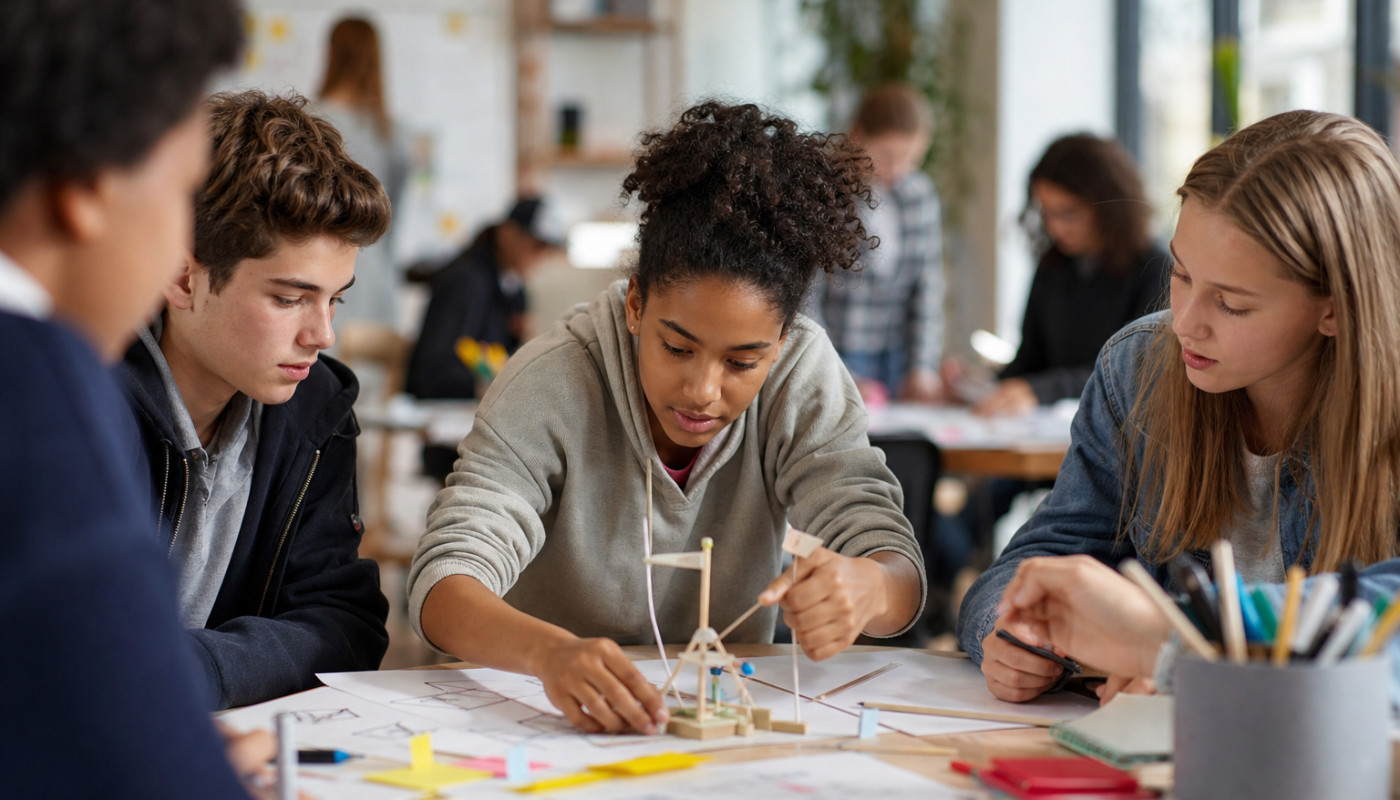
Design thinking did not start in schools, yet education has become one of its most visible new frontiers. Popularised in business and product development, the approach is typically taught as a cycle: empathise with users, define the problem, ideate, prototype, and test, then iterate. In classrooms, that translates into students interviewing peers, mapping needs, building rough models, gathering feedback, and revising their work, which sounds straightforward until you realise how different it is from the traditional “right answer” culture that still dominates many systems.
The timing helps explain the momentum. Over the past decade, countries have accelerated curriculum updates around so-called “21st-century skills”, and international assessments have been nudging schools toward applied learning. The OECD’s PISA 2022 cycle, for example, placed creativity and problem-solving closer to the centre of what systems say they value, while employer surveys consistently put critical thinking, communication, and adaptability near the top of hiring priorities. Design thinking fits that agenda because it turns those skills into visible steps, and it gives teachers a structure to run complex projects without losing the thread.
There is also a pragmatic reason it spreads so easily: it travels well across subjects. In a literature class, “empathise” can mean interviewing community members and writing from lived experience; in science, it can mean designing a low-cost test or a prototype device; in civic education, it can mean reworking a public-service campaign after audience feedback. The method offers a common language, so a school can align projects across departments, and students can transfer habits of mind from one class to another, rather than treating every subject as a sealed box.
Why students learn differently with it
One question keeps coming back in staff rooms: does design thinking improve learning, or just make school feel more modern? The strongest argument is less about novelty and more about cognition. When students are asked to define a problem precisely, generate multiple solutions, and test a prototype against real feedback, they are practising metacognition, the ability to think about their thinking, and that tends to correlate with better academic performance across contexts. The approach forces students to externalise their reasoning, to show their work in a literal sense, which makes misunderstandings easier to diagnose and correct.
It also changes motivation. A worksheet is addressed to the teacher, but a prototype or a pitch is addressed to a user, an audience, a stakeholder, and that shift matters. Research on project-based learning suggests that authenticity and public-facing work can raise engagement, particularly for students who do not thrive in purely abstract tasks. When the “user” is a younger class, a local association, or even the student’s own family, feedback becomes immediate and consequential, and iteration stops being a punishment for getting it wrong, it becomes the normal path to getting it better.
Collaboration is another lever, and it is not the soft add-on it is sometimes treated as. Design thinking, when done seriously, assigns roles, manages constraints, and requires negotiation, which can make group work more accountable. Students learn to argue for an idea with evidence, to concede when testing contradicts intuition, and to document decisions so others can build on them. Those are workplace behaviours, but they are also academic behaviours, and they can be taught explicitly through the rhythm of the design cycle.
Yet the gains depend on implementation. Without time for iteration, design thinking risks becoming theatre, a single brainstorm dressed up as innovation. Without clear learning goals, students may produce attractive projects that skim content knowledge. The more successful classrooms are usually those where teachers connect each phase to disciplinary standards, and where reflection is built in, so students can explain not only what they made, but why they made those choices, and what evidence changed their minds.
AI enters the loop, and raises the stakes
Design thinking is now colliding with a second major shift: the arrival of generative AI in everyday learning. Used well, AI can accelerate several steps of the process, from synthesising interview notes to generating alternative concepts, outlining user journeys, or stress-testing a plan against constraints. That speed can free class time for higher-value work, such as deeper research, better prototypes, and more rigorous evaluation. Used poorly, it can flatten the process into fast answers, weakening the very habits design thinking aims to develop.
The practical question for schools is governance: what counts as legitimate assistance, and what counts as bypassing learning? Many systems are moving toward transparency rules, requiring students to document where AI was used, what prompts were tried, and what changes were made after checking sources. That kind of “process log” aligns neatly with design thinking’s emphasis on iteration and evidence, and it can make AI use more teachable, because teachers can evaluate judgement, not just output. In other words, the assessment focus shifts from the final artefact to the decision-making trail behind it.
This is also where tooling matters. If students are expected to prototype quickly, test ideas, and revise based on feedback, they need accessible support, and that increasingly includes AI assistants that can help them organise research, draft alternatives, or simulate stakeholder questions. For educators exploring that layer, you can try here, a resource that illustrates how AI assistants are being positioned for structured tasks, not just casual chat, and that distinction is crucial in a design-thinking context.
Still, the stakes are higher than convenience. Equity issues emerge fast: if some students have powerful tools at home and others do not, project-based learning can widen gaps unless schools provide consistent access. Data protection is another pressure point, particularly when student work includes sensitive interviews or community information. The safest practice is to minimise personal data, use school-approved platforms, and treat AI outputs as drafts requiring verification, because the core of design thinking is not speed, it is responsibility toward users and evidence.
What it changes for teachers and schools
Design thinking alters the teacher’s job in ways that are easy to underestimate. In a conventional lesson, a teacher can plan a linear path: instruction, practice, assessment. In a design-thinking project, the path branches constantly, and teachers become facilitators of uncertainty, guiding students through ambiguity without solving the problem for them. That demands new classroom management skills, more formative assessment, and often more coordination across staff, because projects rarely fit neatly into a single period or a single subject.
Time is the first structural constraint. Iteration requires slack, and many timetables are built for coverage, not cycles of testing and revision. Schools that embed design thinking at scale often adjust schedules, creating longer blocks, shared planning time, or interdisciplinary project weeks. Space matters too. Maker spaces and flexible classrooms are not just aesthetic upgrades; they support rapid prototyping and visible work, and they allow teachers to observe process, not only outcomes. Even low-cost solutions, movable desks, whiteboard surfaces, simple craft materials, can shift a room from consumption to creation.
Assessment is the second constraint, and arguably the most political. Standardised testing still drives incentives, and teachers may fear that open-ended projects will reduce exam readiness. Some schools respond by mapping design-thinking projects directly to tested standards, then using rubrics that score both content mastery and process skills, such as quality of research, clarity of problem definition, and evidence of iteration. Portfolios are gaining ground because they can capture growth over time, and they allow students to show drafts, feedback, and revisions, which is where much of the learning sits.
Finally, professional development becomes decisive. A short workshop can introduce the vocabulary, but it rarely changes practice. Teachers need model units, coaching, and time to reflect on what failed, because design thinking involves risk, and classrooms are high-stakes environments. When leadership treats iteration as normal for adults as well as students, the method becomes sustainable; when it is framed as a quick innovation mandate, it often burns out after a year, leaving behind posters and little else.
Getting started without wasting a semester
Start small, and budget realistically. A first project can run in three to six weeks, using inexpensive materials, and focusing on a local need that allows real interviews and real feedback. Book time for iteration, reserve a shared space if possible, and check whether municipal, regional, or philanthropic grants support innovation, digital tools, or maker equipment in schools. The strongest results come when goals, access, and assessment are set upfront.
Similar

Invisible Connections: How Everyday Orders Shape Your Regulatory Records

Exploring The Benefits Of Free AI Chat Services For Businesses

Quantum Computing: The Next Technological Revolution